Origins
The
Victoria Place Historic
District
was developed from a portion of the Dennis
Addition, a quarter section of land platted in 1883
and annexed into the City in 1899. The Dennis
Addition was named for John T. Dennis, one of
the earliest pioneer homesteaders of the desert adjacent
to the Phoenix townsite.
In 1895, the
Brill Street trolley car line was extended through the
Dennis Addition, making the area readily accessible
to the central commercial core or Phoenix. The area
remained undeveloped and rural in character until
Roosevelt Dam was completed in 1911 and Arizona
was granted statehood in 1912. Both events, together
with agricultural development in the Valley, sparked a
boom in real estate development and residential
subdivision.
The
Development of Victoria Place
Victoria Place
was initially a pair of two-acre lots, each individually
owned by FX O'Brien and Eric Hanson. The lots were
positioned back-to-back and surrounded by larger
five-acre parcels, which had, been platted before the
housing demand at the turn-of-the-century. Population
growth after 1912 necessitated denser urban
neighborhoods be established closer to the
Phoenix townsite.
O'Brien's and Hanson's lots measured 200 x 875 feet,
however, only the two shorter sides had street frontage.
Neither of the parcels was large enough to be developed
into the standard pattern of the area, so the two men
merged their lots into a single subdivision. They laid
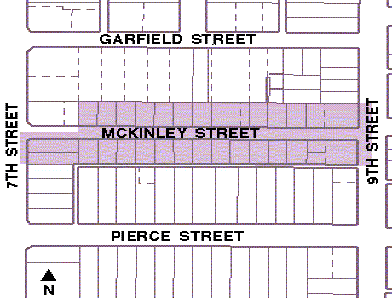
out McKinley Street,
which was initially lined with Ash trees, to run east
west down the center of the parcel. This enabled lots
with a standard 50-foot width, but only an 80-foot
depth. The street right-of-way could be only 40 feet
wide, narrower than the surrounding streets. This
configuration of a narrow street and smaller lots
established the unique site and spatial characteristics
that distinguish
Historic Victoria Place
today.
Although
F.X. O'Brien and Eric Hanson platted the land, the
primary developer of
Victoria Place was the Valley Construction and
Realty Company. Due to a slowdown in the Phoenix economy
during World War 1, the subdivision developed in two
distinct phases, the first from 1913 to 1920, and the
second from 1924 to 1930. All of the homes in the second
phase were completed after the war and before the
effects of the Depression hit Arizona in 1930.
Victoria
Place was a typical middleclass neighborhood for
early Phoenix. The residents were a mixture of many
segments of society. Occupations of residents ranged
from sales clerks and service sector employees to
Southern Pacific Railroad workers.
Homes in Victoria Place
original
cost was between $2000 and $2500, compared to $5000 and up
in the wealthier neighborhoods developed in the same
period. The appearance of Victoria Place illustrates the
rapid shift in architectural design and styles that
occurred before and after World War I. The west end of
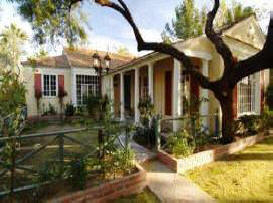
McKinley Street, built prior to the war, is almost
entirely Bungalow Style homes. The houses constructed
after the war are in the Spanish Colonial Revival
Style. This second phase of Victoria Place also
illustrates the growing prominence of the automobile;
almost every home has a carport, while the earlier
Bungalows do not. The contrast in the architectural
styles, and the feeling of density created by the narrow
street, is a unique characteristic of Victoria Place.
The
Architecture of Victoria Place
At the time Victoria Place was first subdivided, the
Bungalow was the prominent architectural style in
Phoenix. Bungalows are typically one-story homes with a
simple, functional floor plan and one or more broadly
pitched roof gables with deep overhangs. Broad front
porches with tapering porch columns are a typical
feature. Bungalow was the common architectural style,
which emerged from the Craftsman movement at the
turn-of-the-century. The Craftsman philosophy reflected
the increasing informality of twentieth century
lifestyles oriented to comfort, utility and convenience.
Individual contractors using mail order blueprints or
mass-produced plans constructed most Bungalows.
By the time construction in
Victoria Place
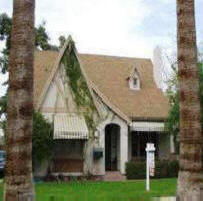
resumed after 1924, the Spanish Colonial Revival
had overtaken the Bungalow
as the prevailing local style. Stylistic elements of the
Spanish Colonial Revival Style include
low-pitched roofs with little or no overhang, red tile
roof shingles, prominent arches over doors, windows and
porches, and an asymmetrical stuccoed facade.
Significance of Victoria Place
To Phoenix located in one of the earliest additions
to the Phoenix Townsite,
Victoria Place is
historically important for its association with the
subdivision of the
Dennis Addition as the
Phoenix townsite expanded, and as a vestige of
neighborhood development in Phoenix in the first decades
of the 1900's. The distinct lot and street size set it
apart from its surroundings and document its unusual
development pattern. Architecturally, Victoria Place
is important for its representation of the two
predominant residential building styles in the community
during the early twentieth century: Bungalow and
Spanish Colonial Revival.
Historic Preservation
Office of the City of Phoenix Neighborhood Services
Department
200 West Washington Street
Phoenix, Arizona 85003
(602) 261-8699
|

Laura Boyajian
Mobile: 602.400.0008
HistoricCentralPhoenix@cox.net
HomeSmart, LLC
5225 N. Central Ave. #104
Phoenix, AZ 85012
(602)
400.0008

|