|
History Plus Light Rail Access
The Progression of Residential Architectural Styles and Building Materials in Central Phoenix, 1910- 1956
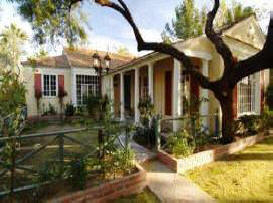
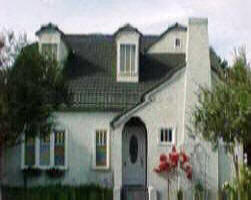
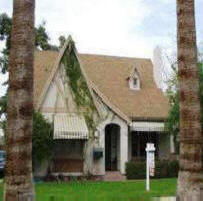
Early and mid-twentieth century neighborhoods in Phoenix illustrate the entire range of nationally recognized residential architectural styles for the period. Each Phoenix neighborhood is distinguished by examples of prevailing styles. These styles include Bungalows, Revivals, and Modern Movement designs. Perhaps unique to the area is the popularity of the Spanish Revival, Southwest, and Pueblo Revivals during the 1920’s and 1930’s. Often these designs used adobe blocks, borrowing an earlier Sonoran vernacular tradition and adapting it to architect-designed houses. Frame wood and brick were common building materials in the early twentieth century. Stucco was often used to provide a finished sheathing over exterior walls. Following World War II, a shortage of building supplies prompted builders to use whatever materials were at hand, resulting in a diversity of materials in the late 1940s. However, by the mid 1950s mass-produced concrete masonry units become the most popular building material.
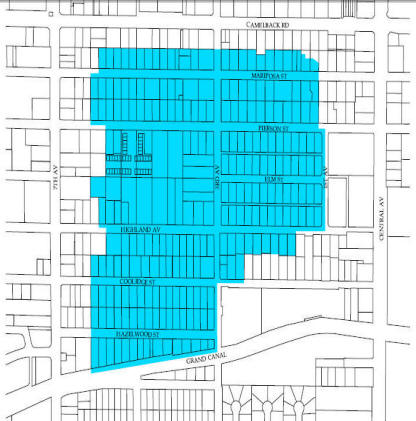
The area's first plat, Suburban Acres, was recorded in 1924, outside city limits but within a ten- minute drive to downtown. A series of Pierson Place plats followed as the city’s official population continued to expand during the 1920s. In 1926 Pierson Place was platted, followed by Pierson Place Amended and South Pierson Place in 1927, and Stanley Place in 1928. Del Monte Park was the last area within the district to be recorded, just after World War II ended in 1946.
By 1956 the area was mostly built out with single family homes and small scale multifamily buildings that include duplexes, triplexes, and four-plexes. Larger-scale multifamily complexes began appearing as infill in the late 1950's. Commercial development occurred outside the edges of the district at 7th Avenue, Camelback Road, and Central Avenue. In 1963, a multistory residential tower was constructed in the neighborhood on Central Avenue. The first plat in the Pierson Place survey area was Suburban Acres, recorded in 1924, west of Central Avenue, and adjacent to the Grand Canal to the south. Lots in the original plat ranged from two-thirds of an acre to a full acre. The one-acre lots were eventually subdivided into quarter acre parcels and sold for single-family homes and small multi-family complexes. What remains of these residential buildings were constructed over a thirty year period beginning in 1924.
In 1926 three couples, Eugene and Lena Pierson, N.C. and Hazyl Pierce and J.P. and Ruth Matz, began subdividing a series of Pierson Place tracts. One of the roads in the new neighborhood was named Pierson Street. The 40-acre tract was initially split into one-acre lots, each anticipated to have at least one house, in a suburban area expected to be among the biggest growing areas in Phoenix. The intent was to allow the large lots to be divided to make the purchase entirely profitable. Lots were deep, with houses set well back from the road, to ensure privacy and leave sufficient room for planting gardens.
Matz and Pierce also became involved in developing part of the subdivision. They owned a forest, from which some of their lumber for the project was cut, and a sash and door mill, which came to supply most of the window and door materials for their development. Early Pierson Place ads boast of "a distinctive class of homes at a moderate cost." The "modern" subdivision had a number of English and other period revival style homes, constructed for sturdiness with brick and Celotex ceiling insulation. "So confident [was] he of its future", that Mr. Matz and his wife built their home in the new neighborhood in 1926. E.M. Pierson and his wife lived at 300 W. Mariposa (their home site is now a parking lot).
The next year the three couples also recorded Pierson Place Amended, subdividing the area from their original plat. In the amended plat, Mariposa Street split the 300 foot deep lots, which created one third acre parcels. Two of these larger single family residential parcels still remain; the majority were later split into 8,500 square foot lots. Two of the neighborhood’s adobe houses were built on these larger parcels, including a distinctive Pueblo Revival Style with exposed adobe block at 3rd Avenue and Mariposa Street.
The Southwestern Sash and Door Company, owned by Matz and Pierce, also subdivided South Pierson Place in 1927. Hazlewood Street was named after Hazyl Pierce. Most of the one-half plus acre lots were subsequently split again, though the area was not developed with single family and multifamily complexes until the 1930s and 1940s.
By 1928, a new builder was involved in homebuilding in the northern portion of the neighborhood. E.W. d'Allemand offered fifth acre lots in addition to one acre and half-acre lots, which sold from $395 and up, depending on the location and depth. Streets came fully graded and capped with caliche and gravel, which gave hard surface streets without any paving assessments to pay. Lots were supplied with water from a high pressure, deep water well as well as telephone and electrical service. Homes sold on both a speculative and made-to-order basis, and by October 1928 twenty homes were built and in the amended Pierson Place tract. Restrictions called for houses that cost at least $2,500, exclusive of the lot, to ensure "a happy medium for good development." Deed restrictions also limited ownership only to Caucasians. The developers specifically marketed to families whose children would be attending Brophy College, a 1500 student college preparatory school just three blocks west of the their neighborhood.
Harry Jones subdivided Stanley Place in 1928. He carried the grid street pattern over from the amended Pierson Place plat immediately west, continuing Camelback Road, Mariposa and Pierson Streets between 3rd to Central Avenues. However, the onset of the Depression slowed development until the late 1930's. A two story Spanish Colonial Revival residence built with adobe was among the first three homes constructed in the new subdivision in 1930.
Development in the neighborhood picked up in the late 1930's with the availability of FHA mortgages. In 1936 the Gold Spot Investment Company built two new homes in Stanley Place. The company worked with designer and builder David Rubenstein, who designed the houses especially for Phoenix to be fire-proof and termite-proof, using concrete joists in a flat roof, with structural steel sashes.
Homes in the neighborhood were constructed with a variety of materials. Brick was the most common structural wall material used, though block and wood frame houses also appeared. Seven adobe homes were constructed in Mariposa and Pierson Streets, further adding to the variety of materials that helped characterize the neighborhood.
Build out in the Pierson Place survey area continued to occur over the first decade after World War II. The Del Monte Park plat was recorded in 1946, and completely built out the following year with modest ranch style homes as well as a small multifamily development of four-plexes. Multi-family infill complexes were built throughout Pierson Place. In the early postwar years, these apartments ranged from collections of one story, single family, duplex, triplex, and four-plex buildings. Larger, multi-unit, two story buildings are associated with the late 1950's and early 1960's.
Neighborhood Character
The proposed Pierson Place Historic District is designed following a grid street pattern, with 60- foot wide roads and vertical curbs. Because the area was in the County when it was primarily built out between 1910 and 1956, there are no sidewalks.
The neighborhood is characterized by an established traditional landscape. Turf, mature trees, and shrubs are prevalent. There is a sense of openness, achieved by the pattern of modestly sized homes on relatively large lots (typical lots are more than 8,000 square feet), with front yard setbacks that often exceed 30 feet. Many of the houses have detached rear garages. Attached carports are more prevalent on homes from the 1940’s and 1950’s, and carport additions are a common pattern of alteration seen in the neighborhood. Other alterations include carport enclosures, room additions, window replacements, stucco applied to exterior walls, and painted brick.
A sense of uniformity is achieved within the neighborhood by the pattern of setbacks, house size, and scale. Most houses are one story. At the same time, Pierson Place illustrates a diverse range of architectural styles, building types, and materials as a result of its long period of build-out beginning in the 1920’s and continuing into the early 1960’s. In the late 1950’s, the pattern of small scale development gave way to infill with larger, modern multifamily complexes, often characterized by two stories and multiple units within each building.
Property Types, Architectural Styles, and Building Materials
Most of the buildings in the proposed Pierson Place Historic District are single family houses. However, fifteen percent of the properties are multifamily complexes, comprised of collections of detached single family buildings, duplexes, triplexes, and four-plexes. A range of architectural styles reflects several decades of build out. Early neighborhood styles include Bungalows and a number of different period revivals. English Cottages, Pueblo Revival, Spanish Colonial Revival, and Southwest Style houses are all found within the neighborhood. Early modern designs, including an Art Modern house and several International Style houses, are also found in Pierson Place. In the late 1930’s and 1940’s, and the early 1950’s, the district continued to build out with modern Ranch Styles. The Transitional Ranch, French Provincial, Early, and Simply Ranch sub styles are well represented in the neighborhood.
In addition, a palette of exterior wall and roof materials also exists within the proposed historic district. While most buildings have roofs sheathed with asphalt shingles (77%), built up roofs, wood, asbestos shingles, and tiles are also used. Brick is the most common wall material, found on 56% of the houses. Adobe is used in the construction of three percent of the houses, and block and frame wood with shingles, siding, or stucco are also typical of materials found in Pierson Place.
Residential Neighborhood Development in Phoenix, 1910-1956
In the early decades of the twentieth century, most early subdivision activity was initiated either by individuals or building companies subdividing small land parcels into residential lots. Phoenix began to experience rapid growth after 1912 following completion of the Roosevelt Dam, which assured the area a stable water supply. Population grew as a result of agricultural productivity, demand for cotton, the expansion of citrus ranching, and the beginning of the Valley’s tourist industry.
The increased population brought demand for new housing. Most new homes were constructed for specific clients. However, by the late 1920’s larger residential developments began appearing in and around the city, and builders began construction on speculation.
Until the Depression, individual developers funded most building activity. This system of financing collapsed following the stock market crash of 1929, which plunged the nation into a Depression. In the 1930’s the federal government became involved in guaranteeing mortgages for home construction in an effort stimulate new jobs and stabilize the housing market. By the late 1930’s, larger investment companies also began to appear. These influences encouraged both infill developments in existing neighborhoods as well as larger scale residential subdivisions. A variety of architects, planners, realtors, and builders, often functioning as small to mid-scale developers, remained firmly engaged in the construction of residential subdivisions in the Phoenix metropolitan area in the post World War II period. As a result, a number of medium and large tract home developments became especially popular in the suburbs of Phoenix.
Influence of Federal Housing Policies on Phoenix Residential Architecture and Subdivision Planning, 1934-1956
With thousands of homes entering foreclosure nationwide during the Depression, the federal government was compelled to intervene in the nation’s housing market for the first time. As part of the New Deal, Congress passed the first National Housing Act in 1934. Pursuant to the Act over a million short-term mortgages were refinanced and replaced with new, long-term loans. The National Housing Act also created a stable network of savings and loan institutions whose deposits from small savers were directed toward home construction and mortgages.
In addition, this Act established the Federal Housing Administration (FHA). Through the FHA, the federal government insured private, long-term mortgages for home construction and purchase. One to four family properties were insured under Section 203 of the Act, while Section 207 covered properties with five or more units.
The FHA program was initiated in Arizona in January 1935. Banks with facilities in 22 Arizona cities offered FHA insured loans up to 80% of the appraised value, not to exceed $16,000, for new construction or to purchase homes already built. Loan terms could be stretched as long as twenty years, with a fixed rate of five percent plus a one percent fee for service and insurance charges. The following year, the FHA set aside its rule that all new construction be in urban areas, allowing subdivision development outside the corporate limits of cities and towns. In the late 1930’s in Phoenix and elsewhere this helped encourage development to spread out from the central core to suburban locations, a practice that emerged to become a hallmark of postwar subdivisions. By 1940, 2,100 new construction mortgages totaling $8.3 million were insured statewide under the FHA. Most of this development occurred in the Phoenix area.
In addition to the staggering number of new single family detached homes built nationwide under the provisions of FHA’s Section 203, the program supported construction of duplexes, triplexes and four-plexes. These structures were particularly popular in the late 1940’s as the nation struggled with a severe housing shortage following the end of World War II. Small equity investors often put up their life savings to build a modest multifamily complex, sometimes living in one unit and renting the others to generate income.
The Housing Act of 1956 liberalized terms for FHA multifamily construction under both Section 203 and Section 207. These changes, along with the shifting American demographic patterns and rising land prices, contributed to an upswing in new apartment projects beginning in 1957. Under the new Section 207 terms, mortgage ceilings were raised from 80 percent to 90 percent of project value, with allowance for $2,250 per room or $8,100 per unit if rooms in the project averaged less than four per unit. Many of the restrictions on the operation of the completed projects were also removed. Most importantly, equity participation requirements fell to from ten to three percent. The National Housing Act of 1956 also raised the multifamily housing loan limit under Section 203 for duplexes, triplexes and four-plexes to $15,000 for the total project or $2500 per family unit. In spite of this change, small apartment developments became less common in the second postwar decade as the trend in rental housing projects was increasingly larger in scale.
As a result of the FHA influence, the diversity of housing forms that characterized earlier twentieth neighborhoods in Phoenix would give way to patterns of uniformity and consistency, particularly in the post World War II period. In the process, many of the subdivisions built out in the 1930’s, 1940’s and early 1950’s exhibited a transitional pattern of development, borrowing from both old and new practices.
Additionally, The original mix of single family homes with small duplexes, triplexes, and quads gives Pierson Place Historic District a unique personality that feels more city-like than most of our historic districts. To that original mix, sprinkle in some multi-unit rentals built during the 1950's and 1960's, and the very first high-rise living in the city at the 17-story Landmark Towers on Central.
Information Courtesy of The Historic Preservation Office of the City of Phoenix Neighborhood Services Department
200 West Washington Street
Phoenix, Arizona 85003
(602) 261-8600
|